
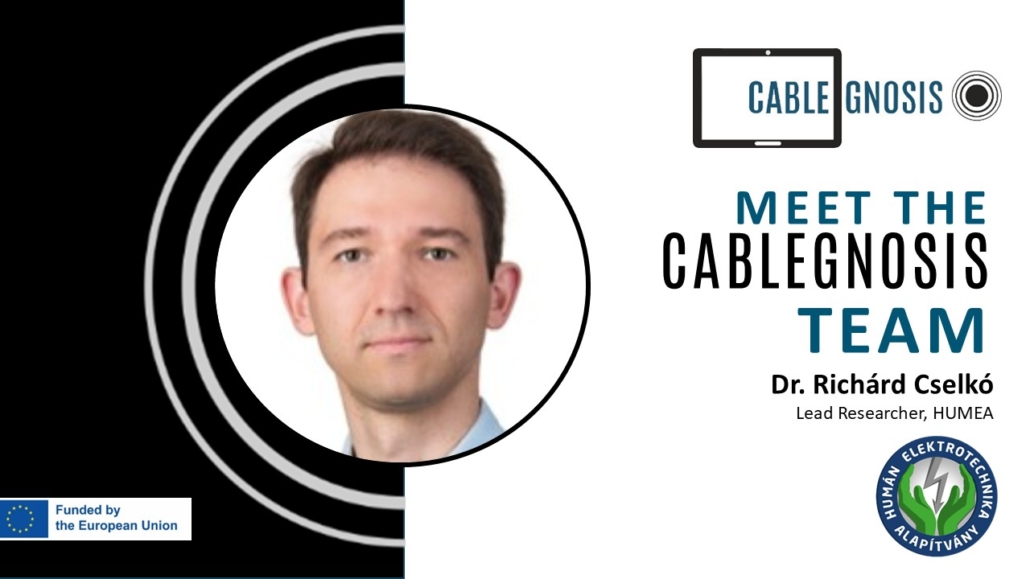
#MeetTheCABLEGNOSISTeam Interview Series
Interview with Dr. Richárd Cselkó, Lead Researcher at HUMEA
We are excited to feature the latest interview in our #MeetTheCABLEGNOSISTeam series—an initiative that brings you closer to the people behind the CABLEGNOSIS project. Today, we introduce Dr. Richárd Cselkó, a valued partner of CABLEGNOSIS and Lead Researcher at HUMEA. In this interview, he talks about his team’s role in CABLEGNOSIS, their ongoing research activities at HUMEA, and what drives their contribution to the project.
“My goal has always been to improve the technologies to better serve the society and make less harm to the environment and people” – Lead Researcher at HUMEA
Can you introduce yourself and share a bit about your background?
I have been involved in research on electrical insulation and high-voltage processes for 15 years. My goal has always been to improve the technologies to better serve society and cause less harm to the environment and people. My focus area is how electrical insulation in high voltage systems can be operated more safely and how premature or unexpected failures can be prevented. On the one hand, this is the basis for efficient use of such systems, while also piquing my interest in technologies that help reduce waste at the end of the equipment’s lifetime.
What is HUMEA’s role in the CABLEGNOSIS project?
HUMEA, which is collaborating with and supporting the activities of the High Voltage Laboratory at the Budapest University of Technology and Economics, is involved in the technical work packages and is leading a task to recycle insulation for reuse in the manufacture of lower-voltage cables. This is a step forward, as in most cases, only the metallic parts are recovered. Polymeric parts, if recycled, are used only in low-end applications. We are developing and testing a separation technology that could ultimately enable the circular use of polymeric materials. This technology has two major steps. The first is to separate the materials, and the second is to establish a process for using the recovered material.
From your point of view, why is innovation in cable recycling important?
Although recycling of commercial packaging materials is now widely practiced (although with its own shortcomings), in case of industrial waste, usually only the most valuable materials are recycled. This is due to the complexity of recycling processes and the ease of the application of new materials. If research and innovation can make recycling more efficient, it can become more attractive to the industry, ultimately leading the way to circularity in terms of all materials.
What are the biggest challenges you face in the project—and how are you addressing them?
The variety of cable types and the seemingly minor, but process-wise important differences in properties makes is harder to establish generally appliable solutions. We address this issue by collecting as many types of samples as possible and evaluating the developed process on all of them.
What are your expectations from the project? What kind of impact do you think CABLEGNOSIS will have on the energy ecosystem?
CABLEGNOSIS includes a wide variety of technological developments, which cover the complete lifetime of a cable system – from basic design to installation, operation, monitoring, and diagnostics. Considering all of these, I expect CABLEGNOSIS to make a step forward in all phases of cable life, which synergistically has a significant impact.
Thank you for this, Richárd.
You can find HUMEA’ research work related to the CABLEGNOSIS project below:
- Markovits, B. Bihari, L. Székely, R. Cselkó, István and Kiss, “Brief Review and Experimental Evaluation of Electrostatic Separation Methods for Electric Waste,” 2025 10th International Youth Conference on Energy (IYCE), Budapest, Hungary, 2025, pp. 1-4, doi: 10.1109/IYCE66046.2025.11155063.
- Markovits, G. Bánhegyi, L. Székely and R. Cselkó, “A Review of Trends in Cable Technology: Novel Materials, Recycling, and Rejuvenation,” 2025 10th International Youth Conference on Energy (IYCE), Budapest, Hungary, 2025, pp. 1-7, doi: 10.1109/IYCE66046.2025.11155023.
Interested to have a better insight on HUMEA ‘s activities, please visit Humán Elektrotechnika Alapítvány


